It’s time to make San Pablo Avenue a street that’s designed for people.
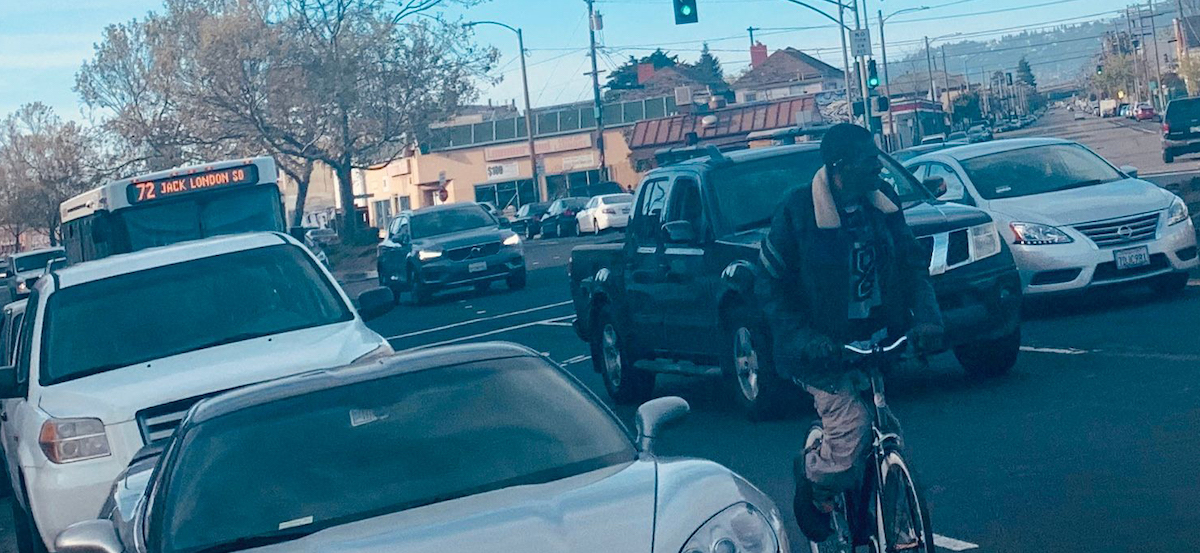
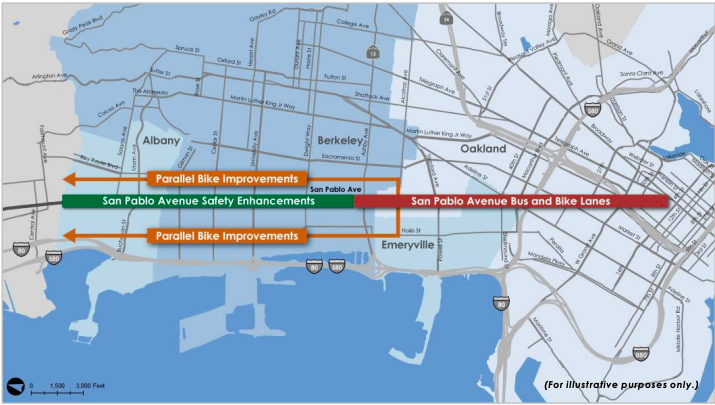
San Pablo Avenue is a busy arterial road serving four Alameda County cities – Oakland, Emeryville, Berkeley and Albany as well cities in western Contra Costa County. It connects neighborhoods, businesses, schools, BART, and bus services. For most of its length, San Pablo is a congested street for motor vehicles and in its current state unwelcoming to other forms of transportation including cycling and walking.
This corridor desperately needs safety and accessibility improvements:
- According to CCTA, between July 2020 and June 2025, 35 people were severely injured and 6 people were killed (in the stretch along El Cerrito, Richmond, and San Pablo alone).
- It is a high-injury route with the third highest number of collisions in Alameda County.
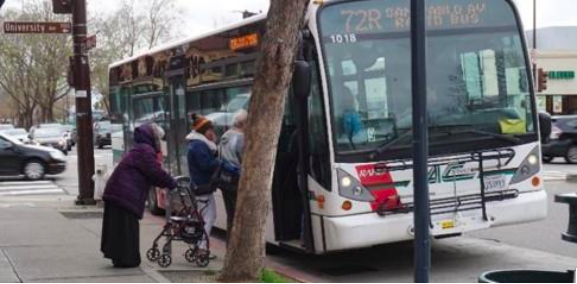
- AC Transit serves more than 10,000 riders a day on this corridor. However, buses experience delays due to traffic congestion.
- San Pablo Ave has no dedicated bike facilities, and there are no parallel bike routes through West Oakland and Emeryville.
Our Work
In 2019 Alameda County launched the San Pablo Avenue Corridor Project to identify short- and long-term improvements that address the increasing multimodal demands along the San Pablo Avenue Corridor. Some of the needs WOBO and its fellow organizations have independently identified are:
- Protected bike lanes the whole way
- Bus only lanes the whole way
- Safer pedestrian crossings
Why have projects on San Pablo been delayed?
The Alameda County Transportation Commission (ACTC) is in the preliminary design phase of the San Pablo Avenue Corridor Project, focusing on targeted small-scale changes to improve pedestrian, bicyclist, and transit rider safety. These include:
- Pedestrian safety improvements, such as pedestrian curb ramps and crossing improvements
- Bicycle safety improvements to provide a comfortable and continuous route along the corridor
- Transit priority treatments such as dedicated bus lanes to improve travel time and reliability, transit signal priority, signal modernization and coordination, and enhanced bus stops
Ssee ACTC’s Project Fact Sheet for more details.
The previous 2026 project start estimate was pushed to 2030, and with a three year construction timeline, the earliest the project might be complete is 2033! The project cost has also ballooned to $250 million, and no funding has been secured as of Fall 2026.
These delays have real safety impacts–since 2020 there have been five pedestrians killed by a drivers on this part of San Pablo Ave. In the same period there have been over 20 severe injury crashes. Many of these crashes happened on the West Oakland segment south of West MacArthur Blvd, where the city already has their own paving project planned for 2028.
Pedestrians, cyclists, and bus riders need safety improvements now, not in 2033 or later! Bike East Bay has started a petition to urge OakDOT to implement safety upgrades in the 2028 paving project, rather than waiting for the Alameda County project that may happen years later. Take action by signing the petition here!
Sign the petition by Bike East Bay urging the Oakland DOT to implement safety upgrades on San Pablo Ave via the 2028 paving project, and to not wait for the Alameda County project to come together before acting on these needs.
If you’d like to be added to the Alameda County San Pablo Avenue Project email list to be alerted of future opportunities for input, email sanpabloave@alamedactc.org.
Sign up for WOBO”s monthly e-newsletter to receive updates about this campaign.
Make a donation to Walk Oakland Bike Oakland to support our work on this campaign!